9 Best Push Lawn Mowers for Rough Terrain (November 2026)
The best push lawn mowers for rough terrain include the BLACK+DECKER Electric Lawn Mower for rough edges and tight spots, the Greenworks 60V 21in Self-Propelled Lawn Mower for large bumpy yards, and the LawnMaster LMRM1401 Push Reel Lawn Mower 14-Inch for small even patches.
On this page (6 sections)
The best push lawn mower for rough terrain for most homes is the BLACK+DECKER Electric Lawn Mower, a 9.9 lb 3-in-1 tool that switches from mowing to trimming and edging without a second machine. For a large uneven yard, the Greenworks 60V self-propelled mower drives itself over slopes and thick grass.
Rough ground is not one problem. It can mean tree roots, a lumpy back lot, a slope, or thick weeds along a fence.
The right mower depends on which of those you face most often.
This guide covers nine mowers for uneven yards, in order by score, and what each one does well. If you want a fuller field of gas options, our gas push mower roundup covers models that suit heavier work.
For steeper ground, the push lawn mower for hillside mowing post goes deeper on slopes.
Our picks at a glance
-
1
 Best for rough edges and tight spots
BLACK+DECKER Electric Lawn Mower
9.7/10 our score
See it on Amazon -
2
 Best for large bumpy yards
Greenworks 60V 21in Self-Propelled Lawn Mower
9.6/10 our score
See it on Amazon -
3
 Best for small even patches
LawnMaster LMRM1401 Push Reel Lawn Mower 14-Inch
9.5/10 our score
See it on Amazon
- 4
 Check it
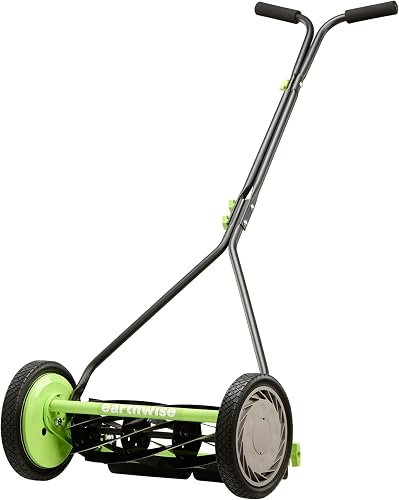
Earthwise 1715-16EW 16-Inch 7-Blade Push Reel Lawn
Best for warm-season grasses - 5
 Check it
Greenworks 25322 40V 16-Inch Push Mower
Best for light uneven yards - 6
 Check it
LawnMaster MEB1114K 15-Inch Corded Mower
Best for budget uneven lawns - 7
 Check it
PowerSmart EasyCut 18-Inch 144cc Gas Mower
Best for tall thick grass - 8
 Check it
BILT HARD 15-Inch 11-Amp Corded Mower
Best for small yards on a long cord - 9
 Check it
Scotts 304-14S 14-Inch Reel Mower
Best for a tidy patch without fuel
Which push mower handles rough terrain best?
The top score goes to the BLACK+DECKER combo tool for edges and tight spots, while the Greenworks self-propelled mower wins for larger bumpy yards. Below is why each one earns its place on uneven ground.
BLACK+DECKER Electric Lawn Mower: Best for rough edges and tight spots
- 3-in-1 mower, trimmer and edger
- 6.5 amp motor with POWERDRIVE transmission
- 12-inch cutting width
- 9.9 lb with adjustable handle
A light combo tool that mows, trims and edges rough boundaries where a full mower deck cannot reach.
Pros
- Three tools in one
- Very light at 9.9 lb
- Cord retention system
Cons
- Single cutting height
- Needs an extension cord
BLACK+DECKER suits a yard with rough borders, fence lines and sidewalk edges rather than wide open lawn. The 6.5 amp motor with POWERDRIVE transmission gives it enough torque for tough weeds and thick grass.
The 12-inch cutting width and 1.6-inch cutting height keep it a precision tool, not a field mower. Detach the mower deck and it becomes a string trimmer, then rotate the head to edge along a rough path.
At 9.9 lb it is easy to lift over roots and curbs.
The Automatic Feed Spool keeps line moving without bumping the head, so trimming along a long fence does not turn into a stop-and-restart chore. An adjustable handle and height positions help you find a grip that keeps the deck level on uneven ground.
The included MTD100 deck, AF-100 spool, auxiliary handle and guard mean it arrives ready to work in all three modes.
The trade-off is reach and cut height. It runs on a cord, so pair it with an extension lead that fits your yard, and it cuts at one height, so it suits trimming and edging rather than a full overgrown lot.
A cord retention system reduces accidental unplugs, but the lead still follows you around beds and trees. Treat this as the cleanup tool beside a bigger mower, not a replacement for one.
Greenworks 60V 21in Self-Propelled Lawn Mower: Best for large bumpy yards
- Rear-wheel drive self-propelled
- 60V brushless motor
- Two 4.0 Ah batteries
- 7 cutting heights from 1 to 4 inches
Rear-wheel drive carries you over thick grass and slopes, and the 21-inch deck covers uneven ground faster.
Pros
- Drives itself on slopes
- Covers up to 3/4 acre per charge
- 4-in-1 mulch, bag, discharge and leaf pickup
Cons
- Heavy at 65 lb
- Premium price tier
Greenworks suits the largest and most uneven yards here. Rear-wheel drive traction sets your pace on slopes and thick grass, so you guide the mower instead of pushing it.
The 60V brushless motor runs on two 4.0 Ah batteries and covers up to 3/4 acre per charge, which suits big lots. Seven cutting heights from 1 to 4 inches let you start high over rough ground and step down.
Rear-wheel drive is the right layout for slopes because the powered wheels sit under the weight of the deck.
The 4-in-1 system handles mulch, bagging, side discharge and turbo leaf pickup. LED lights help with early or late mowing.
The dual-port turbo charger refills both batteries, and the auto switchover keeps the deck running when one pack drains. A vertical fold on the handles helps it fit a tight shed.
At 65 lb it is the heaviest pick, and a premium tier price reflects the batteries and drive system. The IPX4 rating and rust-proof aluminum handles add durability for a mower left outdoors.
Choose it when your rough terrain is large enough that pushing a basic mower wears you out.
LawnMaster LMRM1401 Push Reel Lawn Mower 14-Inch: Best for small even patches
- 5-blade reel
- 10-inch front wheels
- 4 cutting positions from 1 to 2.5 inches
- No gas or battery
Big front wheels roll over small bumps, and the scissor cut keeps trimmed patches healthy.
Pros
- Large 10-inch front wheels
- No fuel or charging
- Hardened steel blades
Cons
- Needs a fairly level lawn
- No engine assist
LawnMaster suits a small yard with short grass and mild bumps. Its 10-inch front wheels are the largest front wheels here, so they roll over dips better than small wheels.
The 5-blade reel cuts like scissors, which avoids tearing grass and keeps a healthy lawn tidy. Four cutting positions from 1 to 2.5 inches let you raise the deck for slightly longer grass.
A 14-inch cut and a 21.96-inch overall length keep it compact in a shed.
There is no gas or battery, so it starts every time and needs little upkeep. The hardened steel blades are built to last, which matters because a dull reel is the main thing that spoils the cut.
The motorless design also means no fumes, no charging and no fuel to store between mowings.
The catch is uneven ground: a reel mower needs a fairly level lawn, and thick weeds will stall the blades. Deep ruts can also make the reel ride high and skip grass.
At under 2.5 inches at its top setting it is a short-grass tool, so it suits a kept patch rather than a neglected lot.
Earthwise 1715-16EW 16-Inch 7-Blade Push Reel Lawn: Best for warm-season grasses
- 7-blade ball bearing reel
- 16-inch cutting width
- 10-inch composite wheels
- Cutting height from 0.5 to 2.5 inches
A wider reel with seven blades that suits Bermuda, Zoysia and other tough warm-season grasses.
Pros
- Seven blades stay sharp longer
- Wide 16-inch cut
- Seven height positions
Cons
- Struggles with tall weeds
- Manual power only
Earthwise suits warm-season lawns such as Bermuda, Zoysia, Centipede and St. Augustine, which the maker lists as suitable.
The 7-blade ball bearing reel stays sharp longer than a basic reel.
Its 16-inch cut is wider than the LawnMaster reel, and 10-inch composite wheels handle small bumps. Seven height positions from 0.5 to 2.5 inches give finer control over a short cut.
The alloy steel blades and steel side plates give it a sturdier feel than the price tier suggests.
The trade-off is again the reel design. Tall weeds and deep dips will need a pass with a rotary mower first.
A reel also works best when you mow often and cut no more than a third of the blade, so a patch left to grow over winter is a poor match. On a maintained lawn with only minor roughness, it is a quiet, low-maintenance choice that also cuts grasses the push reel on the Scotts is too narrow for.
Greenworks 25322 40V 16-Inch Push Mower: Best for light uneven yards
- 35% lighter than steel deck mowers
- 5-position height adjust
- Mulch and rear bagging
- 40V 4.0 Ah battery
A lightweight battery mower that is easy to lift over dips and borders in small uneven yards.
Pros
- Light build
- Cuts up to 1/3 acre per charge
- Shares batteries with 75+ tools
Cons
- 16-inch deck is narrow
- Push only, no drive
Greenworks suits small uneven yards where weight matters. This mower is 35% lighter than steel deck mowers, so lifting it over curbs and roots is easy.
The 40V 4.0 Ah battery cuts up to 1/3 acre per charge, and a single lever sets five heights from 1.25 to 3.75 inches. Mulch and rear bagging cover the clipping routine, and the battery works with more than 75 Greenworks 40V tools.
Push-button start means no pull cord and no fumes, which helps in a tight side yard.
The 15.67-inch deck is narrow, so it takes more passes. Push-only drive means you supply the effort on grades.
At 37.5 lb it is light for a battery mower but heavier than the corded and reel picks, so lifting it over a fence line is a two-hand job. The clipping bag comes in the box along with the battery and charger.
For a modest bumpy lawn, it is a light and quiet pick.
LawnMaster MEB1114K 15-Inch Corded Mower: Best for budget uneven lawns
- 11 amp corded motor
- 3,300 RPM
- 5 cutting positions from 1.4 to 3 inches
- 7.75-inch rear wheels
Larger rear wheels help roll over lumpy ground, and the corded motor keeps costs down.
Pros
- Tall 7.75-inch rear wheels
- 28 lb and folds flat
- 7-gallon collection bag
Cons
- Cord limits reach
- Narrow 15-inch cut
LawnMaster suits a budget yard where the ground is lumpy but small. Its 7.75-inch rear wheels roll over small ruts, and the 11 amp motor spins at 3,300 RPM.
Five cutting positions from 1.4 to 3 inches let you raise the deck over dips. It weighs 28 lb and the push handle folds for tight storage, and the 7-gallon bag holds clippings.
The 15-inch cut and compact 26.9-inch body make it easy to steer around beds and narrow strips.
Corded power keeps the cost down but limits where you can go. The cord is the weak point on rough ground, where it catches on roots and drags through wet grass.
The 15-inch cut is narrow, so a big lumpy lot takes many passes. This is a good fit for a flat to gently uneven lot close to an outlet.
PowerSmart EasyCut 18-Inch 144cc Gas Mower: Best for tall thick grass
- 144cc 4-cycle OHV engine
- Side discharge
- 5-position height from 1.5 to 3.9 inches
- 8-inch rear wheels
Side discharge pushes clippings out of the way, so the deck keeps moving through overgrown patches.
Pros
- Side discharge clears tall grass
- Steel 18-inch deck
- High 3.9-inch top cut
Cons
- No bag included
- Needs gas and oil
PowerSmart suits overgrown grass and tall weeds. Its side discharge throws clippings clear, so the steel 18-inch deck keeps moving through thick growth without clogging.
The 144cc 4-cycle OHV engine has an auto choke and primer for easy starting. Five positions run from 1.5 to 3.9 inches, and the tall top cut is ideal for a first pass over rough grass.
Eight-inch rear and 7-inch front wheels help it roll around trees and beds. The deck folds down in seconds for storage.
The trade-off is upkeep and no bag, so plan on side discharge only. It also needs fresh 87-octane fuel and 10W-30 oil, and oil is not included.
Restarting a warm engine without priming takes care, since extra priming can flood it. See our guide to lawn mower engine size if you want to weigh the 144cc motor against bigger engines.
BILT HARD 15-Inch 11-Amp Corded Mower: Best for small yards on a long cord
- 11 amp motor at 3,300 RPM
- 15-inch cutting width
- 5 positions from 1 to 3 inches
- 9.2 gallon grass bag
A light 21 lb corded mower that stores vertically and handles small rough yards.
Pros
- 21 lb and folds vertically
- Large 9.2 gallon bag
- Instant-stop safety lever
Cons
- Cord needed for every pass
- 15-inch deck
BILT HARD suits a small yard with a long extension cord. The 11 amp motor at 3,300 RPM gives steady cutting power, and the 15-inch deck fits narrow rough patches.
Five positions from 1 to 3 inches cover different grass lengths. It weighs 21 lb and can stand vertically to save floor space.
The 9.2-gallon bag means fewer stops, and a double safety system stops the motor as soon as you release the lever. The 14.5-inch blade inside the 15-inch deck leaves little uncut strip along edges.
The cord is the main limit on rough ground, where leads snag on roots and shrubs. The instant-stop lever is a real help on uneven ground, since it kills the blade the moment you let go near a rock or root.
Storage is the other strong point: folding and standing it upright frees floor space in a small garage. For a compact yard near an outlet, it is a practical low-cost tool.
Scotts 304-14S 14-Inch Reel Mower: Best for a tidy patch without fuel
- 5-blade ball bearing reel
- Cutting height from 0.5 to 1.75 inches
- 8.5-inch composite wheels
- 18.1 lb
A light manual reel for short, well-kept grass where you want no fuel or cord.
Pros
- Very light at 18.1 lb
- Tool-free assembly
- Heat-treated alloy blades
Cons
- Low top cut of 1.75 inches
- Best only on short, even grass
Scotts suits a small, tidy lawn where you want no fuel at all. The 5-blade ball bearing reel and 8.5-inch composite wheels make it light at 18.1 lb.
Three height positions from 0.5 to 1.75 inches give a short, clean cut, and heat-treated alloy blades stay sharp longer. Tool-free assembly means it is ready quickly.
A T-style handle with a cushioned grip helps on longer pushes, and the reel snips rather than tears grass.
The low top cut is the main trade-off here: this mower is for short, maintained grass, not tall weeds or deep divots. The maker also advises against mowing wet grass and says to clear debris first, because a reel skips and jams on both.
With only three positions it gives you less room to step down gradually than the Earthwise reel. It works best as a quiet option for a small patch with only minor bumps.
How the push mowers for uneven ground compare
The comparison table lines up every mower here by power source, cutting width and height range. Use it to match a mower to the size of your yard and how rough the ground gets.
| Product | Best for | Power | Cutting width | Cutting height | Our score |
|---|---|---|---|---|---|
| BLACK+DECKER Electric Lawn Mower | rough edges and tight spots | Corded electric, 6.5 amp | 12 in | 1.6 in | 9.7 |
| Greenworks 60V 21in Self-Propelled Lawn Mower | large bumpy yards | 60V battery, two 4.0 Ah | 20.28 in | 1–4 in, 7 positions | 9.6 |
| LawnMaster LMRM1401 Push Reel Lawn Mower 14-Inch | small even patches | Manual | 14 in | 1–2.5 in, 4 positions | 9.5 |
| Earthwise 1715-16EW 16-Inch 7-Blade Push Reel Lawn | warm-season grasses | Manual | 16 in | 0.5–2.5 in, 7 positions | 9.4 |
| Greenworks 25322 40V 16-Inch Push Mower | light uneven yards | 40V battery, 4.0 Ah | 15.67 in | 1.25–3.75 in, 5 positions | 8.5 |
| LawnMaster MEB1114K 15-Inch Corded Mower | budget uneven lawns | Corded electric, 11 amp | 15 in | 1.4–3 in, 5 positions | 8.2 |
| PowerSmart EasyCut 18-Inch 144cc Gas Mower | tall thick grass | Gas, 144cc | 18 in | 1.5–3.9 in, 5 positions | 8.1 |
| BILT HARD 15-Inch 11-Amp Corded Mower | small yards on a long cord | Corded electric, 11 amp | 15 in | 1–3 in, 5 positions | 7.4 |
| Scotts 304-14S 14-Inch Reel Mower | a tidy patch without fuel | Manual | 14 in | 0.5–1.75 in, 3 positions | 7.3 |
How these mowers were compared
We compared specs, not test runs. Our score weighs specs, features and buyer feedback against what you're shopping for.
Power source came first, because corded, battery, gas and manual mowers solve rough terrain in different ways. Wheel sizes, cutting width and height range came next, since they decide how a mower rolls over bumps and handles tall grass.
Weight followed, because lifting a deck over roots and curbs is a daily task on a rough lawn.
We also checked drive type and clipping systems, because self-propelled drive and side discharge change how much effort a rough yard takes. Height ranges got extra weight, since a top cut near 4 inches is what gets you through an overgrown first pass.
Clipping options came next: bagging, mulching and side discharge each suit a different yard. Each pick then got a badge for the job it does best.
What matters most on a rough lawn?
Ground conditions decide more than the engine does. Start with the points below before you pick a model.
Does wheel size matter more than engine power?
Yes on uneven ground, because small wheels dig into ruts while larger ones roll over. Look for bigger front and rear wheels, such as the 10-inch front wheels on the LawnMaster reel or the 8-inch rear wheels on the PowerSmart.
Engine power matters in tall grass, but a light mower with good wheels often beats a heavy one on a lumpy lot. A 12-inch combo tool like the BLACK+DECKER can also get into spots a wide deck cannot reach at all.
Should you choose self-propelled or push only?
Pick self-propelled for slopes and thick growth. Rear-wheel drive traction on the Greenworks 60V keeps the mower moving at your pace.
Choose push only for small or mostly flat lawns where a light body is easier to lift over roots. A weight of 9.9 to 21 lb, as on the BLACK+DECKER or BILT HARD, makes that lifting simple.
On a long slope, the 65 lb Greenworks is the easier machine despite its weight.
Which cutting height setting suits bumpy ground?
Start near the top of the range so the deck clears stones and dips. The PowerSmart reaches 3.9 inches, and the Greenworks 60V goes to 4 inches.
Cut only a third of the blade height per pass, then lower the deck over a few mowings. This also helps a reel mower avoid scalping the lawn on small humps.
Mowers with only a few positions, like the three on the Scotts reel, give you less room to step down gradually.
How do you handle tall weeds in rough patches?
Use side discharge, as on the PowerSmart, so clippings clear the deck. For fence lines and edges, a trimmer attachment like the one on the BLACK+DECKER saves a second tool.
Where the growth is really thick, take the first pass at the highest setting and let the clippings lie. Cutting too low in one go bogs down even a strong motor and leaves clumps that smother the grass underneath.
How much does weight affect a rough-terrain mower?
Weight cuts both ways on uneven ground. A heavy mower holds its line over dips and keeps the deck from bouncing, but it is hard to lift out of a rut or carry up steps.
The 65 lb Greenworks 60V stays planted but needs drive to move it. The 9.9 lb BLACK+DECKER is easy to carry but can chatter over lumps.
Match weight to whether you mostly push across a lawn or lift over borders and obstacles.
Does deck material matter on stones and roots?
A steel deck, as on the PowerSmart 18-inch mower, takes knocks from stones and roots better than plastic. Plastic decks on the lighter battery and corded models keep weight down but are less forgiving on a yard full of debris.
Either way, clear loose stones and branches before you mow. A reel mower is the most sensitive here, since a jammed stick stops the reel and needs the blades checked.
Should you pick battery, corded, gas or manual for rough ground?
Each power source fits a different kind of uneven yard. The options below show where each one wins and where it falls short.
Battery frees you from a cord and starts with a button, so the Greenworks 40V and 60V models suit yards without a nearby outlet. Runtime is the limit on big lots.
Corded models like the LawnMaster and BILT HARD cost less and run without a battery, but the lead snags on roots and beds, so they fit small yards close to a socket.
Gas gives the most sustained power for tall weeds, as with the PowerSmart, at the cost of fuel, oil and upkeep.
Manual reels need no power at all but only suit short, fairly even grass.
Which mower is right for your yard size?
Small patches suit light tools, while large lots need more battery or fuel and a wider deck. Match the mower to the area you cut each week.
What works for a small uneven yard?
A light corded or battery mower, or a reel mower on short grass. The BLACK+DECKER at 9.9 lb is easy to carry over rough edges, and the LawnMaster reel handles small bumps on a tidy patch.
The BILT HARD adds a big 9.2-gallon bag for a small yard that produces a lot of clippings.
What suits a large lot with slopes?
Self-propelled drive and a wide deck. The Greenworks 60V covers up to 3/4 acre per charge with rear-wheel drive and a 21-inch cut, so a big uneven lot takes fewer, easier passes.
Its two batteries and auto switchover mean you are less likely to stop mid-lawn.
When does a gas mower make more sense?
When the grass is tall and thick and the yard is far from an outlet. The PowerSmart's 144cc engine and side discharge keep cutting where a cord would snag and a small battery would run down.
The cost is fuel, oil and more upkeep than the electric picks.
For a full field of gas models, see our Senix gas lawn mower review and the best gas push mower roundup.
Verdict: the best push lawn mower for rough terrain
The BLACK+DECKER Electric Lawn Mower is the best push lawn mower for rough terrain in this group because it handles awkward edges, fence lines and tight spots as a mower, trimmer and edger in one light tool.
Pick the Greenworks 60V self-propelled mower for a large bumpy yard, where drive and a wide deck save real effort. Choose the PowerSmart gas mower if tall weeds and side discharge matter most, or one of the reel mowers for a small, even lawn.
For steeper ground, compare the picks in our push mower for hillside mowing guide before you buy.
Our top 3 picks at a glance
-
1
Best for rough edges and tight spots
BLACK+DECKER Electric Lawn Mower
9.7/10 our score
See it on Amazon -
2
Best for large bumpy yards
Greenworks 60V 21in Self-Propelled Lawn Mower
9.6/10 our score
See it on Amazon -
3
Best for small even patches
LawnMaster LMRM1401 Push Reel Lawn Mower 14-Inch
9.5/10 our score
See it on Amazon
Frequently asked questions
Do I need self-propelled drive on rough ground?
Yes on slopes and thick growth, because rear-wheel drive pushes the mower for you. On mostly flat bumpy lawns, a light push mower you can lift over dips works fine.
What wheel size helps most on uneven lawns?
Bigger front and rear wheels roll over ruts and humps with less digging in. The LawnMaster reel here uses 10-inch front wheels, and the PowerSmart gas mower runs 8-inch rear and 7-inch front wheels.
Can a reel mower handle a rough yard?
Only small bumps and short grass. A reel cuts best on a maintained lawn, so tall weeds, divots and thick growth call for a rotary mower with a powered deck.
Is a corded mower a bad choice for rough terrain?
It can work if your yard is small and close to an outlet. The cord snags on shrubs and rocks, so plan a path that keeps it behind you and away from tree roots.
How high should I set the deck on rough ground?
Start near the top of the range and cut only a third of the blade height at once. High settings clear stones and dips, then you can lower the deck over a few passes.


